白鷺の舞
Shirasagi-no-Mai
One early morning in April, as cherry blossoms begin their descent and spring settles over Tokyo, we made our way to Senso-ji in Asakusa to witness one of the city’s most enchanting spectacles. Threading through the crowds along Nakamise-dori, past stalls selling thunder crackers and silk fans, we could hear the distant rumble of drums echoing from the temple grounds. the Dance of the White Heron was about to begin, and we couldn’t help but wonder: what ancient story were we about to witness unfold?
What is Shirasagi-no-Mai?
Shirasagi-no-Mai, written as 白鷺の舞, translates directly to “Dance of the White Heron,” though you may occasionally see it called the “White Egret Dance” depending on the translation.
白鷺 – “Shirasagi” means “white heron” or “white egret.” Shira means “white,” while sagi refers to herons and egrets.
の – “No” means “of”
舞 – “Mai” means “dance”
The dance is performed twice annually at Senso-ji Temple in Asakusa. Once on the second Sunday of April and again on November 3rd, which is Culture Day. Each performance occurs twice during the day, typically around 11:00 AM and 2:30 PM, allowing spectators multiple chances to witness this millennium-old tradition.
The Procession
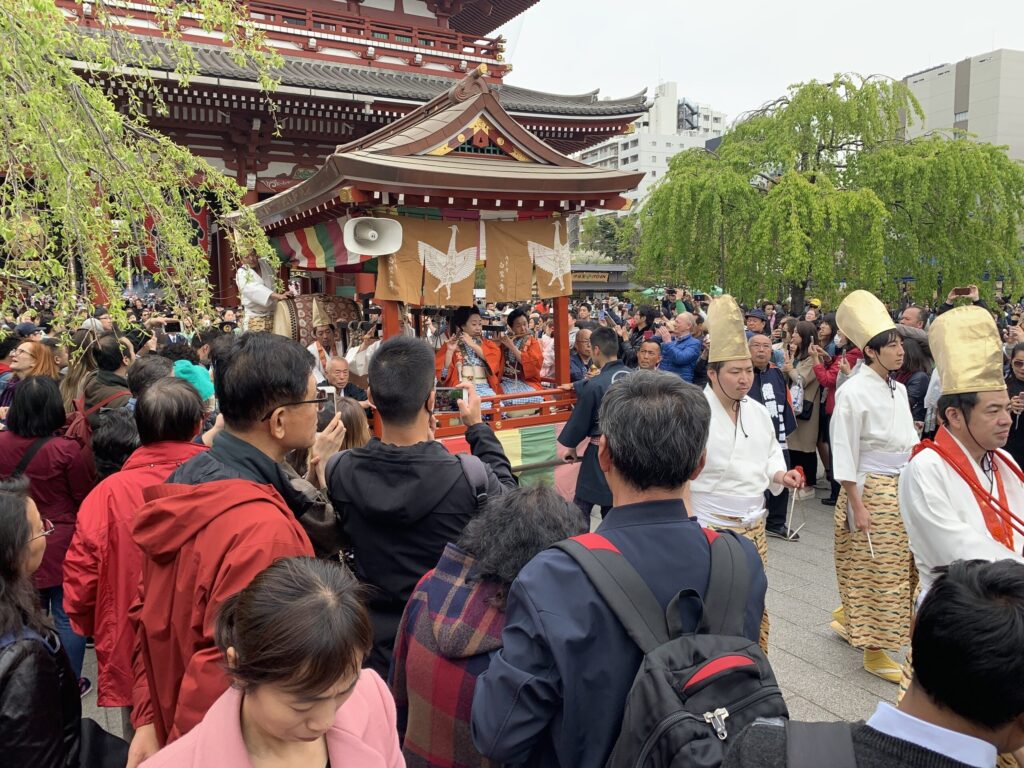
Long before the dancers appear, crowds begin to gather along the Nakamise shopping street. Local kindergarten children, dressed in matching Heian-period costumes with beaming faces, line the pathway. Then the procession emerges from halfway down Nakamise, and everything changes.
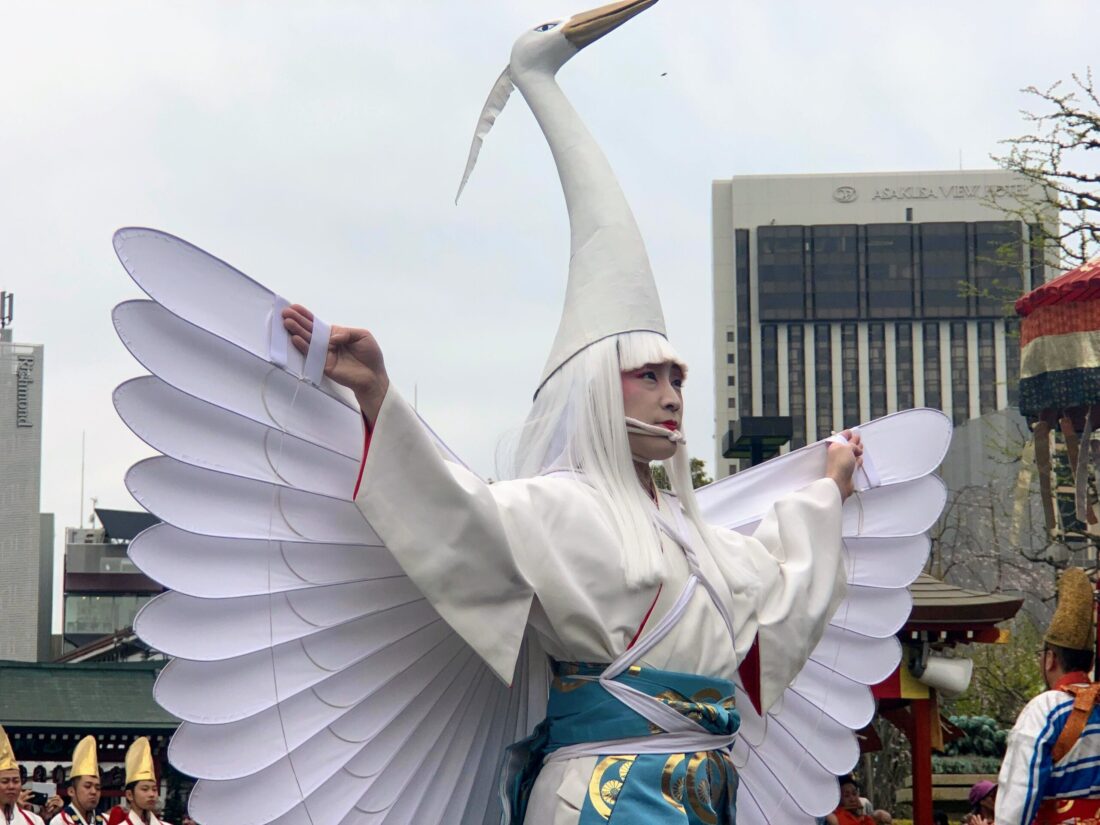
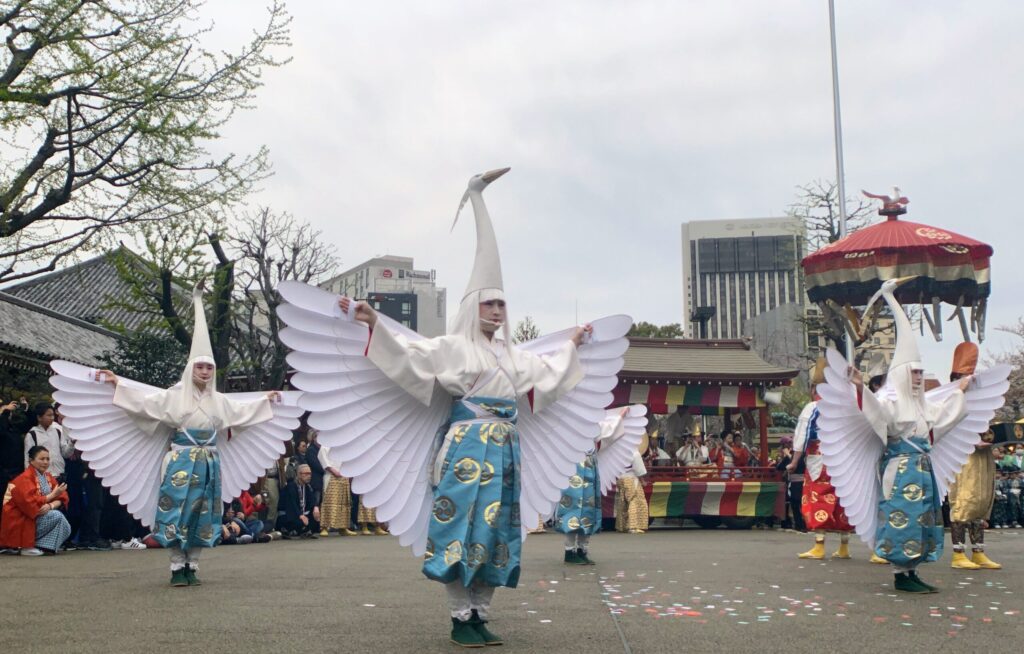
The parade includes eight dancers dressed in elaborate white heron costumes and stunning makeup complete with red eyeliner like the real birds. They are accompanied by three attendants who have different roles — a bird feeder, a baton twirler, and a parasol carrier — as well as a group of guardian children and a float full of musicians. The entire procession moves with deliberate slowness, embodying the graceful, unhurried movements of the Heian period from over a thousand years ago.
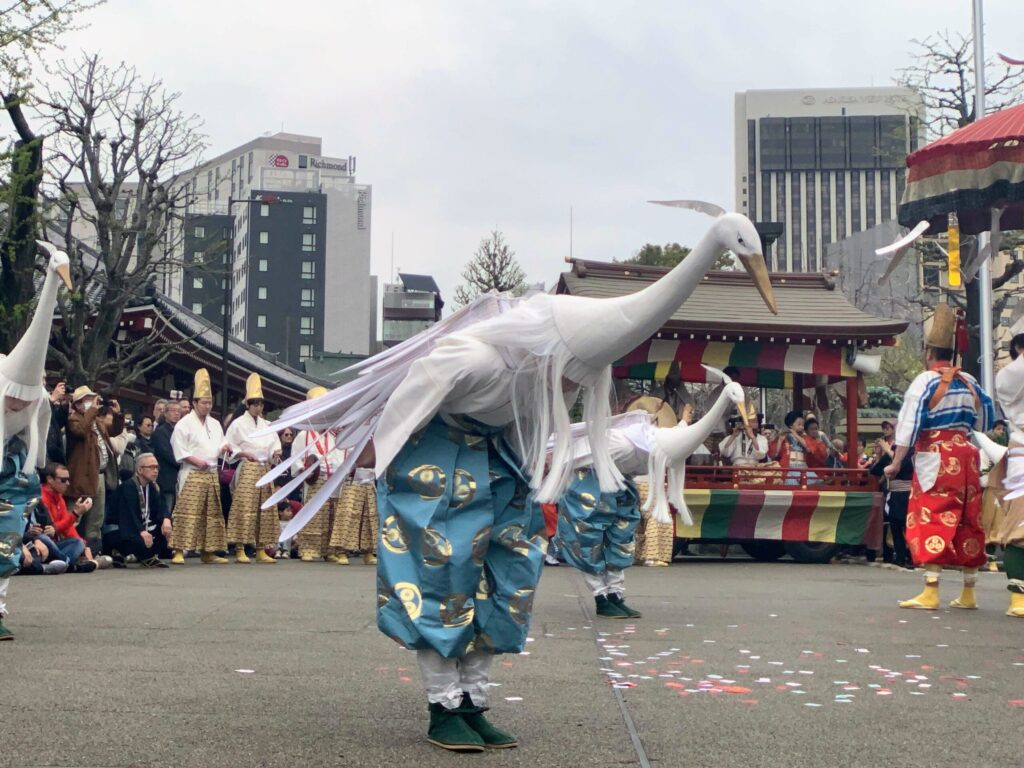
The white heron costumes are breathtaking. Mechanical wing contraptions fold and unfold like giant fans, while the dancers’ faces are painted in the style of Noh theater, with striking red eyeliner mirroring the coloring around a real heron’s eyes. The costumes blend seamlessly with white wigs, creating the illusion that the dancers’ own heads become part of the bird.
As the procession winds through Hozomon gate and up to the steps of Senso-ji Temple, all the heron dancers bow before running inside. The crowd follows, positioning themselves around the performance area to the left of the main temple building.
The Dance
The performance space forms a natural circle, with spectators pressed shoulder to shoulder to catch a glimpse of what comes next. The dance starts really slow with short and strong movements. The music describes the movements and the dancer’s timing is impeccable. Low drumming pounds in tune with the wail of flutes, and suddenly the herons spread their wings for the first time. A delighted gasp ripples through the audience.
The parasol carrier stands strong at the center while the bird feeder runs forward, tossing handfuls of paper confetti from her chest; a symbolic feeding ritual. Members of the audience scramble to collect these pieces of paper, believed to be good luck charms. Meanwhile, the herons move with remarkable precision, trailing after the baton twirler like birds following flock instinct.
The dancers’ imitation is uncannily accurate. They soar with outstretched wings rather than flapping frantically. They balance on one leg without toppling. They bend at complete right angles as they peck the ground, maintaining stiffness in their lower bodies as if their legs were much longer than they really are. It takes little imagination to believe you’re watching real herons moving through shallow water.
The entire performance, from the start of the procession to the final bow, lasts about 30 to 45 minutes. But those minutes feel suspended in time, as if the boundaries between the 8th century and today have momentarily dissolved.
The Symbolism of the White Heron
In Japan, the white heron is seen as a special bird because it can move between three elements: air, earth, and water. This unique ability sets it apart from other creatures and connects it to the spiritual realm. The white heron is a symbol of good luck, celebrated for its ability to move between three elements.
White herons are often depicted in stories and ukiyo-e woodblock prints, acting as messengers of the gods or symbolizing purity and transition. Their striking white plumage has made them subjects of poetry and painting throughout Japanese history, representing not only beauty and grace but also an otherworldly quality that connects the living to something beyond.
The bird can also be seen as a sign of good luck and a bringer of good harvest. For this reason, the original dance was performed to ward off bad luck and disease, beckoning bountiful harvests and good fortune for the coming year.
History of the Dance
The origin of this event is found in the Keian Engi Emaki, a historic picture scroll owned by Sensoji Temple from 1652. This illuminated scroll chronicles the rich history and legends of Senso-ji, depicting various festival processions and rituals performed at the temple during the Edo period. Among these illustrated ceremonies was the White Heron Dance.
The dance itself traces its lineage much further back. A ritual dance called Shirasagi no Mai has been performed regularly at Sensoji temple in Tokyo since 1652, but originates even farther in the past, to about the 11th century. Originally performed at Kyoto’s Yasaka Shrine, the dance is meant to ward off plagues.
However, as centuries passed and Japan modernized, this ancient tradition nearly vanished forever. Shirasagi-no-Mai, the White Heron Dance, is a ceremonial parade inaugurated in November 1968 by the Asakusa Tourist Federation to mark the 100th anniversary of the Meiji era and the 100th year since Edo became Tokyo. It was a conscious effort to preserve and revive a piece of living history that had been depicted in the Keian Engi Emaki scroll but was in danger of being lost.
The dancers make slow, graceful movements that reproduce the elegance of Heian manners from late 8th to 12th century Japan. By recreating these movements, the Asakusa Tourist Federation resurrect a dance and brought a window into Japan’s distant past back to life.
Senso-ji: Tokyo’s Oldest Temple
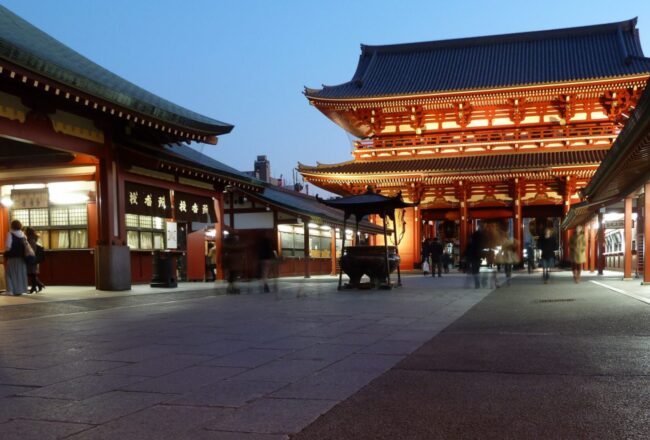
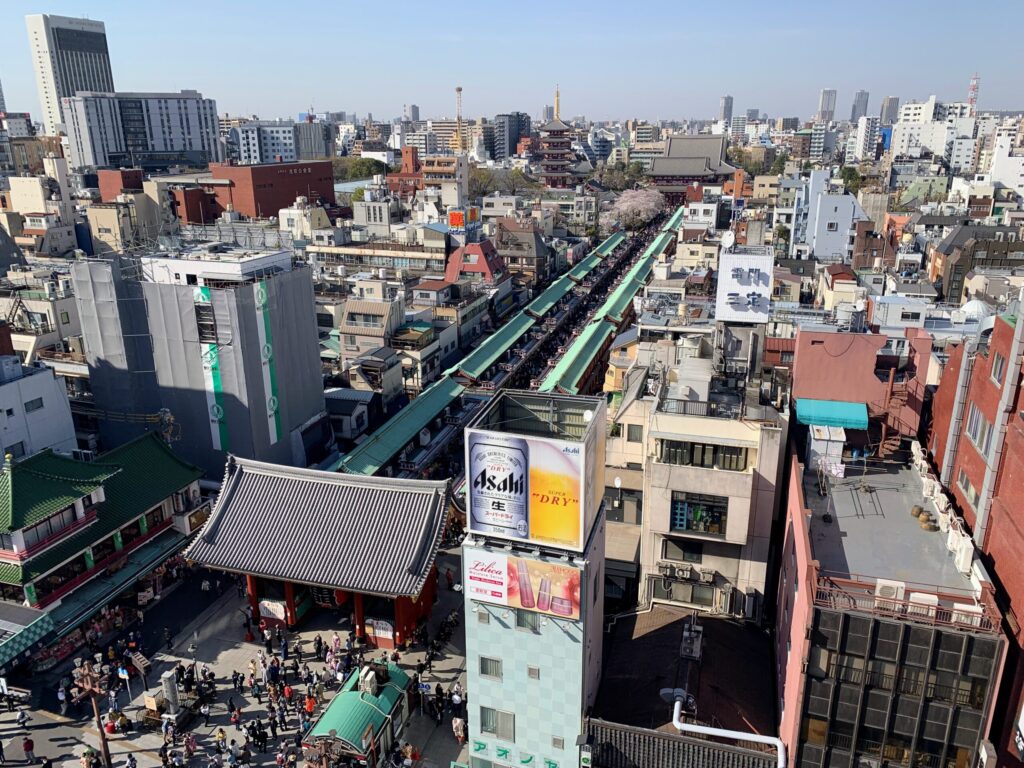
The choice of Senso-ji as the venue for this revival was significant. As Tokyo’s oldest Buddhist temple, founded in 628 CE, Senso-ji has been a center of faith and culture for nearly 1,400 years. The temple’s grounds have witnessed countless ceremonies, festivals, and rituals throughout the centuries. The massive red lantern hanging from Kaminarimon Gate, the incense smoke rising from the great censer in front of the main hall, the steady stream of worshipers throwing coins and praying. This creates an atmosphere where the modern and ancient exist side by side.
When the White Heron Dance unfolds in front of this temple, with incense slowly rising in the background and the weathered temple architecture framing the dancers, it feels less like a performance and more like a portal opening to another time.
Getting There and When to Visit
Senso-ji is located in Asakusa, Taito Ward, Tokyo, and is easily accessible via multiple train lines:
- Tokyo Metro Ginza Line – Asakusa Station (5 minutes on foot)
- Tobu Skytree Line – Asakusa Station (5 minutes on foot)
- Tsukuba Express – Asakusa Station (5 minutes on foot)
- Toei Asakusa Line – Asakusa Station (7 minutes on foot)
The Shirasagi-no-Mai is performed twice per year:
- Second Sunday of April – Celebrating spring
- November 3rd (Culture Day) – A national holiday in Japan
Each performance typically happens twice: around 11:00 AM and 2:30 PM (times subject to change, so check before visiting).
Arrive early if you want a good viewing spot, as the procession draws both locals and tourists. The performance is free to attend.
An Ancient Dance Worth Witnessing
Standing in the crowd that spring afternoon, watching these dancers embody creatures that exist between worlds, I couldn’t help but think about what was nearly lost. How many other traditional dances have disappeared from memory? How many rituals and ceremonies have faded into the mists of time?
The Shirasagi-no Mai stands as a reminder that cultural preservation is an active choice. It takes people who care enough to study old scrolls, reconstruct costumes, learn movements, and pass on knowledge to the next generation. It takes festivals that draw crowds and spark curiosity in young children dressed in Heian costumes who might one day become the dancers themselves.
As the final notes of the flute faded and the herons took their last bow, the audience erupted in applause. The dancers, still in their magnificent white costumes, processed back through the grounds. Children clutched their paper confetti charms. Visitors took photos. And for a brief moment, the boundaries between 1652 and today, between the human and the avian, between the earthly and the spiritual, all felt wonderfully, mysteriously thin.
If you find yourself in Tokyo on a spring Sunday in April or on Culture Day in November, make your way to Asakusa. Let yourself be transported by the drums, mesmerized by the dance, and reminded of how beautiful it is when the past takes flight once more.